Every System's Weak Point
Most computer systems are very well protected against hackers! Even a highly skilled hacker might struggle to break into some systems.
However, every system has the same weak-point: the human!
It is often easier for a hacker to trick a user into revealing a password or sensitive information, than to try to hack into it.
The techniques used to trick users are called social engineering.
Common Social Engineering Techniques
There are lots of different techniques. Here are three of the most common (click to view the details):
Phishing
Pretexting
Shoulder Surfing
Phishing

Fake messages (like an email or text) pretending to be a real company to try to trick you into giving personal information.
Example:
- An email which looks like its from your bank
- It says you need to urgently check your account because of some problem (like a large amount of cash has been taken)
- Clicking the email link takes you to a realistic-looking website
- When you enter your username and password, nothing seems to happen – but it is sent to the hackers for them to use!
Pretexting
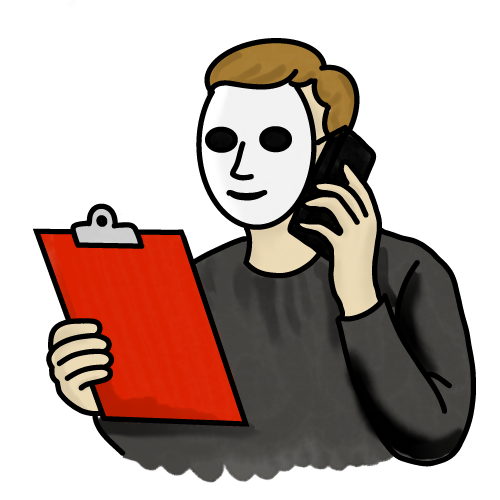
A person pretends to be someone they’re not to get private information from you.
Example:
- A person contacts you saying they are from your broadband provider's security team
- They say there is a problem with your account
- They offer to help you, but say they need your username and password to confirm who you are, or they tell you to install some software
- They can now access your private account or take-over your computer
Shoulder Surfing

Looking over someone’s shoulder to see them typing passwords or other sensitive information
More high-tech examples include:
- Cameras hidden above keypads
- Card skimmers, which copy your bank card details, placed over cash machine card slots